
A wrong photo can delay your entire application. In some cases, the embassy will ask you to resubmit before they even look at the rest of your paperwork.
The U.S. Department of State has strict photo standards for all visa types. These apply equally to tourist visas, work visas, student visas, and immigrant visas.
The rules exist for biometric identification. Your photo is stored electronically and matched against your face at the port of entry. If it does not meet the specifications, the system flags it.
Source: U.S. Department of State Photo Requirements.
If you are applying for a US visit visa, getting the photo right is one of the easiest steps to control. Do not let it become a reason for delay.
💡 Tip: Use a professional visa photo service. It costs a few dollars and eliminates guesswork.
- Format: JPEG (.jpg)
- Minimum resolution: 600 x 600 pixels
- Maximum resolution: 1200 x 1200 pixels
- File size: 240 KB or less
- Shape: Square (height and width must be equal)
- Color: Full color, 24 bits per pixel
Source: U.S. Department of State Digital Image Requirements.
If your photo file is too large, use a compression tool to reduce it below 240 KB. Do not reduce it so far that the image becomes blurry or pixelated.
💡 Tip: If the DS-160 system rejects your photo upload, you can still bring a printed copy to the embassy. Your DS-160 confirmation page will indicate whether the upload succeeded.
If you are preparing your full US visa application, check all document requirements alongside the photo specs to avoid multiple rounds of corrections.
In this article…
Printed vs Digital: Quick Comparison
| Specification | Printed Photo | Digital Photo (DS-160) |
|---|---|---|
| Size | 2 x 2 inches (51 x 51 mm) | 600 x 600 to 1200 x 1200 pixels |
| Format | High quality photo paper | JPEG (.jpg), max 240 KB |
| Head size | 1 to 1 3/8 inches (50% to 69% of frame) | Same proportions as printed |
Both versions must show the same image. The printed photo you bring to the interview should match the digital photo uploaded to your DS-160.
For immigrant visa applicants using Form DS-260, you must submit two identical printed photos on photo quality paper in addition to the digital upload. If you are unsure which form applies to you, our page on how to apply for a US visit visa explains the process.
💡 Tip: Buy travel health insurance before your trip.
Check out popular travel insurance plans and choose one that suits you.
Most plans only cost less than $20 a day.
Photo Size and Dimensions
The printed photo must be exactly 2 x 2 inches (51 x 51 mm). Not approximately. Exactly.
Your head, measured from the bottom of your chin to the top of your hair, must be between 1 inch and 1 3/8 inches (25 mm to 35 mm). That means your head should fill 50% to 69% of the total image height.
Your eyes should be between 1 1/8 and 1 3/8 inches (28 mm to 35 mm) from the bottom edge of the photo. This is roughly the center to upper third of the frame.
If you are uploading to the DS-160 form, the digital version has its own set of specifications covered in the next section.
Examples of Acceptable Photos for USA Visa
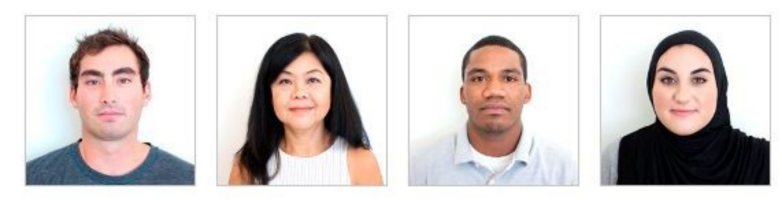
DS-160 Application US Visa Photo Requirements
When applying for a U.S. visa, you will need to submit a recent photograph as part of your application. The DS-160 application asks for specific photo requirements that must be met in order for your application to be accepted.
Here are the US visa photo requirements.
- The photo must be in color.
- It must be taken within the last six months.
- It must be a passport-style photograph.
This means that the photo must be 2 inches by 2 inches, and it must be taken against a white or off-white background. - The photo must be of your full face, and you must be looking directly into the camera.
- You cannot wear anything on your head, including hats, sunglasses, or veils.
- You cannot have anything blocking your face, such as hair or jewelry.
- The photograph must be taken against a white or off-white background.
This ensures that the photograph can be easily scanned and that the facial features of the applicant are clearly visible. - The photo must be taken in front of a plain background.
This helps to prevent the photograph from being distorted when it is scanned. - The photo must be taken with a neutral expression.
This helps to prevent the photograph from being distorted when it is scanned. - The photo must be taken with the head straight and centered in the frame.
This helps to prevent the photograph from being distorted when it is scanned. - The photo must be taken with the eyes open and visible.
This helps to ensure that the photograph can be used to accurately identify the visa applicant. - The photo must be taken with the mouth closed.
This helps to prevent the photograph from being distorted when it is scanned. - The photo must be taken in full-face view directly facing the camera.
This helps to ensure that the photograph can be used to accurately identify the visa applicant. - The photo must be taken with uniform lighting.
This helps to prevent the photograph from being distorted when it is scanned. - The photo must be taken in a high-resolution setting.
This helps to ensure that the photograph can be used to accurately identify the visa applicant.
If you cannot meet these requirements, you will need to take a new photo, that does meet the requirements.
Digital Photo Specifications for DS-160
When completing Form DS-160 online, you must upload a digital photo. The system runs an automated check, but passing that check does not guarantee the embassy will accept it.
Background Requirements
The background must be plain white or off-white. No patterns. No textures. No colors.
Do not stand against a wall with visible paint texture or shadows. Move at least a few feet away from the wall and use front-facing lighting to eliminate shadows behind your head.
Photos taken against blue, gray, or colored backgrounds will be rejected. This includes photo booth backgrounds that appear white but photograph as light gray.
💡 Tip: Stand 3 to 4 feet in front of a white wall. Use a bright, even light source in front of you, not behind you.
No Shadows, Light & Filters
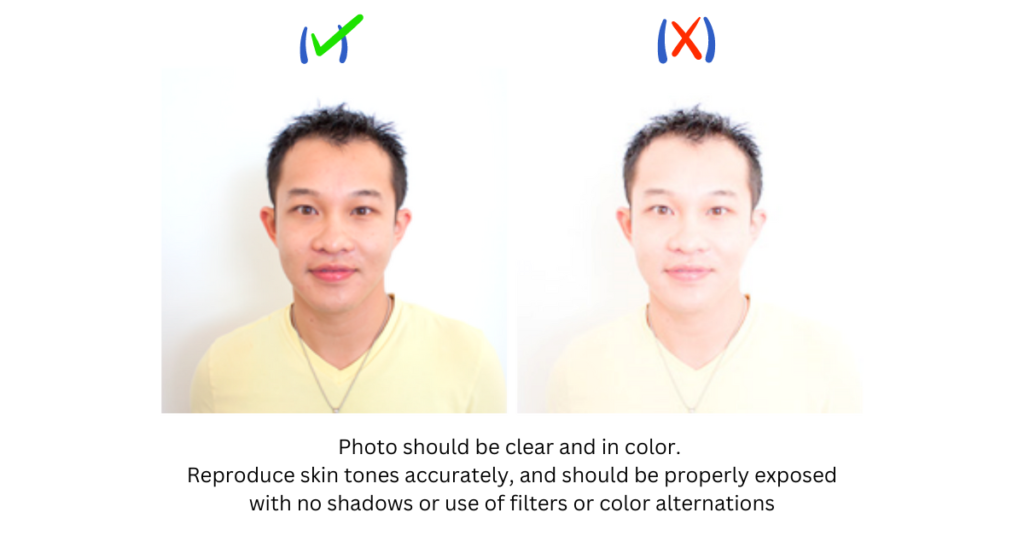
The photo should be clear and in color. Reproduce skin tones accurately, and should be properly exposed with no shadows or use of filters or color alternations.
No Glasses
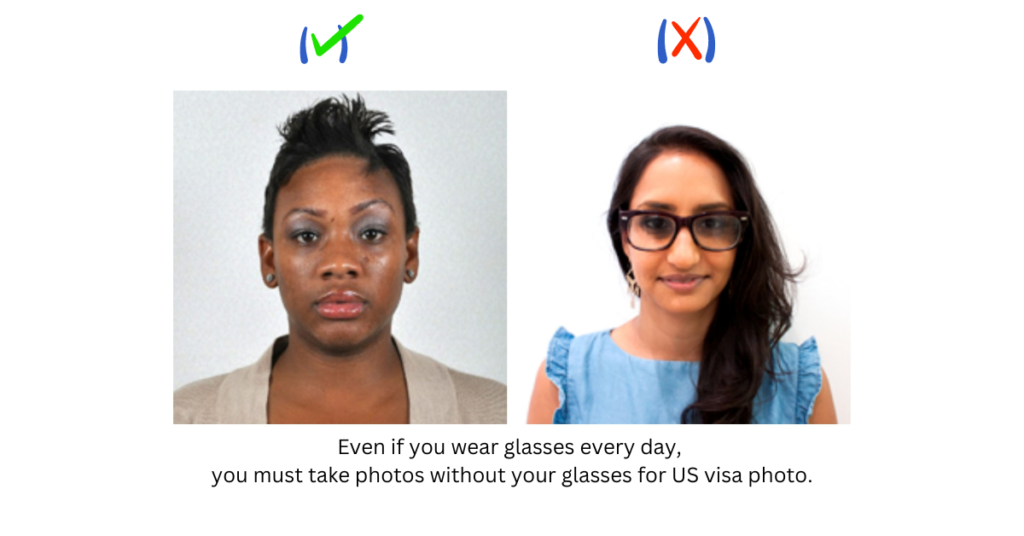
Even if you wear glasses every day, you must remove your glasses for US visa photo.
Since November 1, 2016, eyeglasses are not permitted in US visa photos. This includes prescription glasses, reading glasses, and transition lenses.
The only exception is if you cannot remove glasses for documented medical reasons, such as recent ocular surgery. In that case, you need a signed statement from a medical professional.
If glasses are permitted under the medical exception, the frames must not cover your eyes, and there must be no glare, shadows, or reflections from the lenses. Source: U.S. State Department Photo FAQ.
💡 Tip: Remove your glasses before the photo is taken. Even clear frames can cause rejection.
Do not reuse an older photo where you are wearing glasses. Photos taken before 2016 that include eyewear will not be accepted. If your current DS-160 needs a fresh photo, take a new one without glasses.
Head Position – Centered
Full head should be seen and centered within the photo with proper spacing around the head.
Photo should be 2”x 2” (51 x 51 mm) with the head centered and sized between 1” and 1.4” (25 and 35 mm).
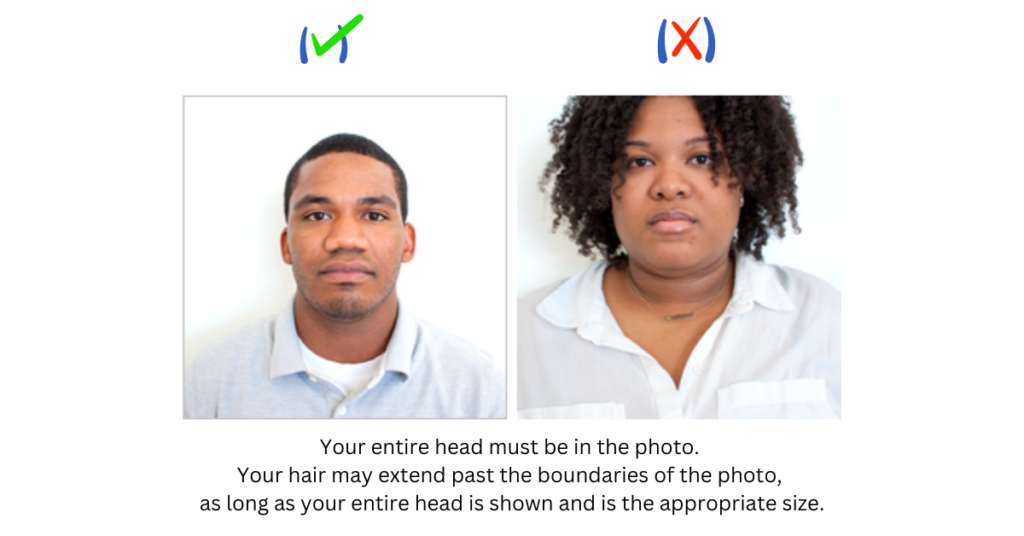
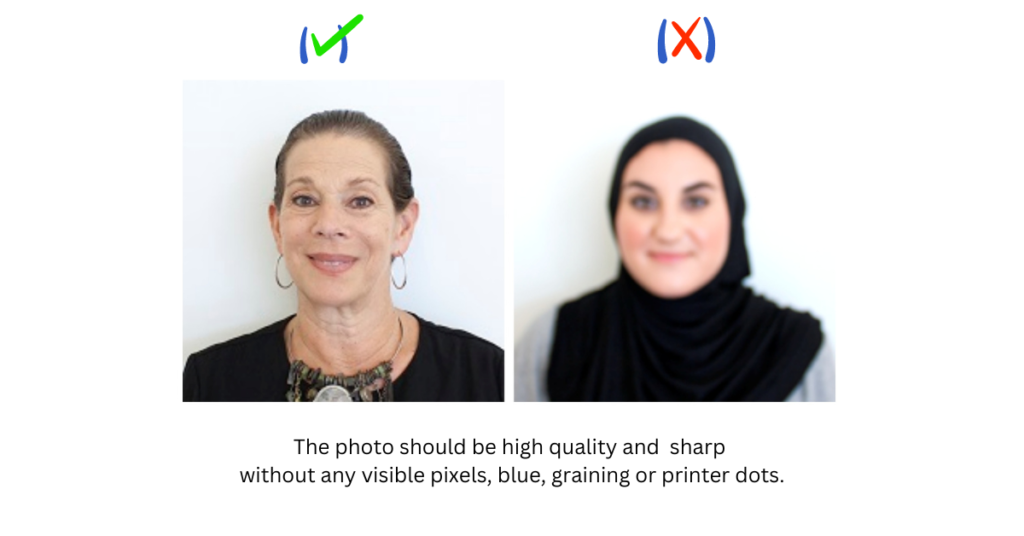
Photo Quality – Sharp without Blur or Pixelations
Make sure the photo is sharp and focused with no pixelations or blurring.
No Digital Editing or Filters
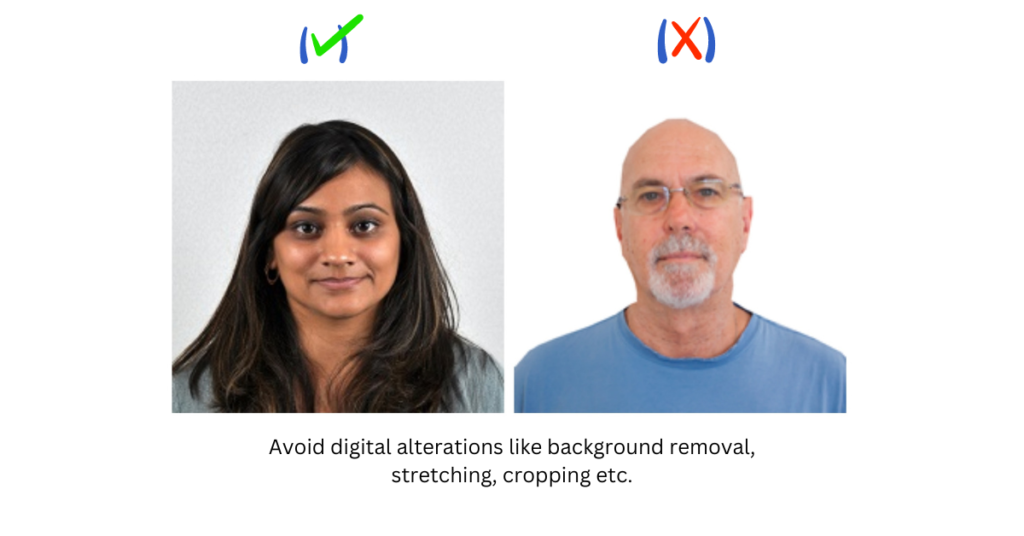
The U.S. Department of State explicitly prohibits digitally altered photos. This includes phone filters, beauty mode, AI enhancement, smoothing, and any software that changes your appearance.
Do not use apps that adjust skin tone, remove blemishes, reshape features, or add effects. Even automatic smartphone beautification features can trigger rejection.
Photos copied or scanned from driver’s licenses, national ID cards, or other official documents are also not acceptable.
💡 Tip: Turn off all beauty and HDR modes on your phone before taking a visa photo at home.
If you are worried about getting your photo rejected after submitting, our guide on common reasons visas get refused covers what else can go wrong.
Do not digitally alter the photo like removing backgrounds, resizing, cropping etc.
Expression and Positioning
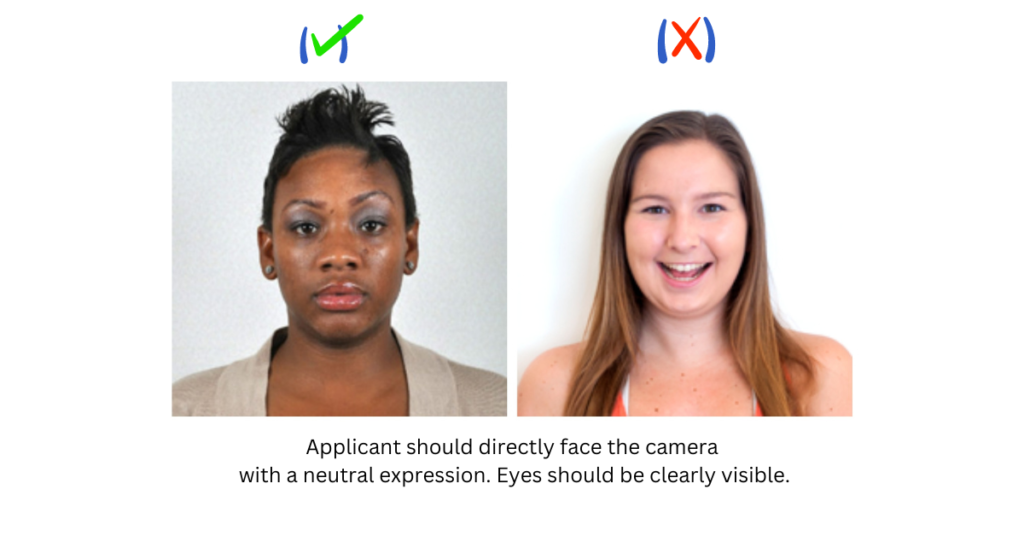
Face the camera directly. Both eyes open. Look straight at the lens.
Your expression must be neutral. A very slight, natural smile is acceptable, but do not show teeth. Do not squint, raise eyebrows, or tilt your head.
Both ears should be visible unless your normal hairstyle covers them. The photo must show your full face from the bottom of your chin to the top of your head, including hair.
If you are also preparing for the US visa interview, your appearance at the interview should closely match your submitted photo.
Have a neutral pose, with eyes clearly visible and head centrally positioned.
Head Coverings and Religious Attire
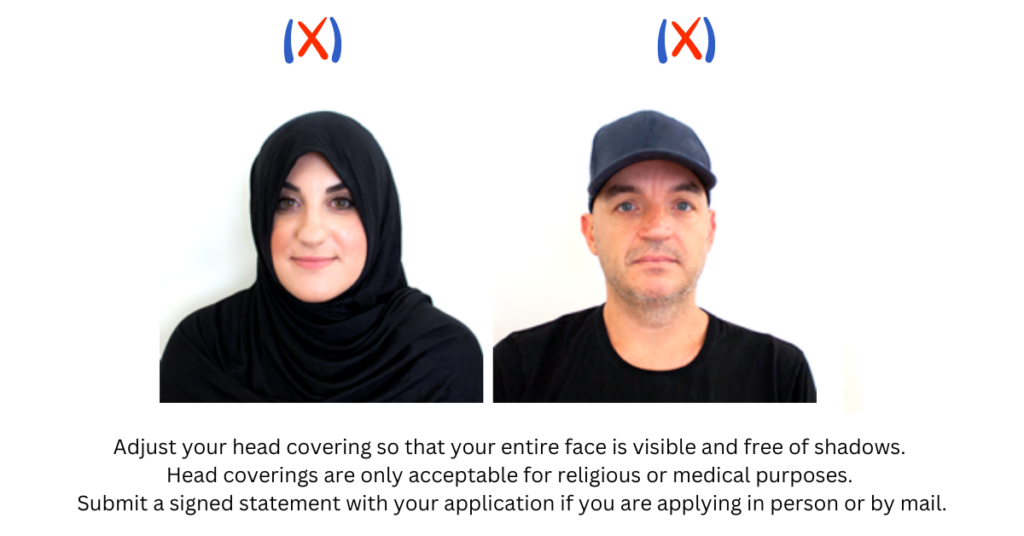
Head coverings worn for religious reasons are allowed. However, your full face from the bottom of your chin to the top of your forehead must be clearly visible.
The covering must not cast shadows on your face. Both sides of your face must be equally lit and fully visible.
Hats, caps, and non-religious headwear are not allowed. Hearing devices and similar medical accessories are permitted.
If you are unsure about a specific accommodation, contact the US embassy or consulate where you plan to apply.
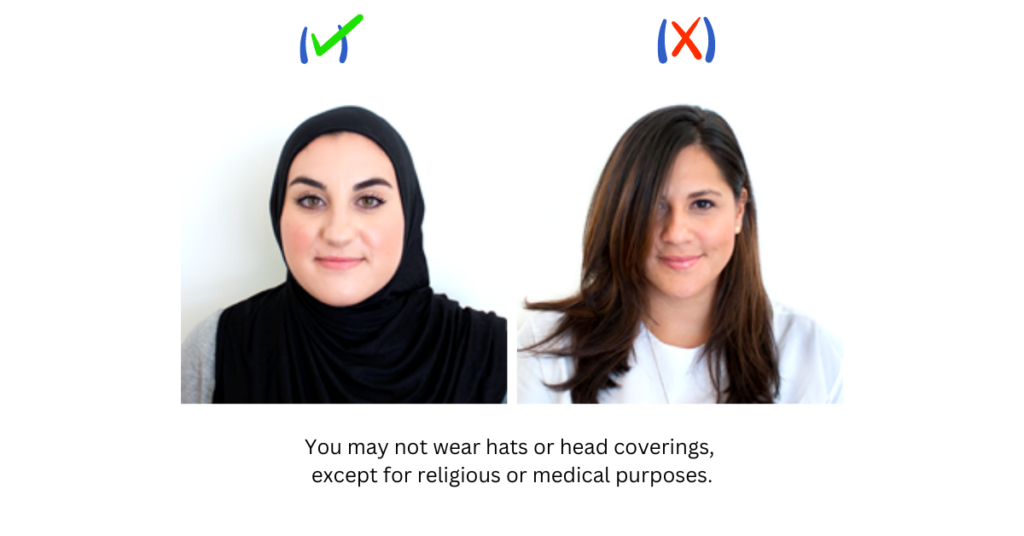
Any kind of attire that covers your full face is not acceptable. Ex: Hats and Religious head coverings that obstruct full face view.
Recency: Must Be Within 6 Months
Your photo must have been taken within the last 6 months. It must reflect how you currently look.
If you have changed your appearance significantly since the photo was taken, such as major weight change, new facial hair, or a different hairstyle, take a new one. The consular officer may ask for a new photo at the interview if your appearance does not match.
If you are renewing a previous visa, do not reuse the old photo. The US visa application process requires a fresh photo every time.
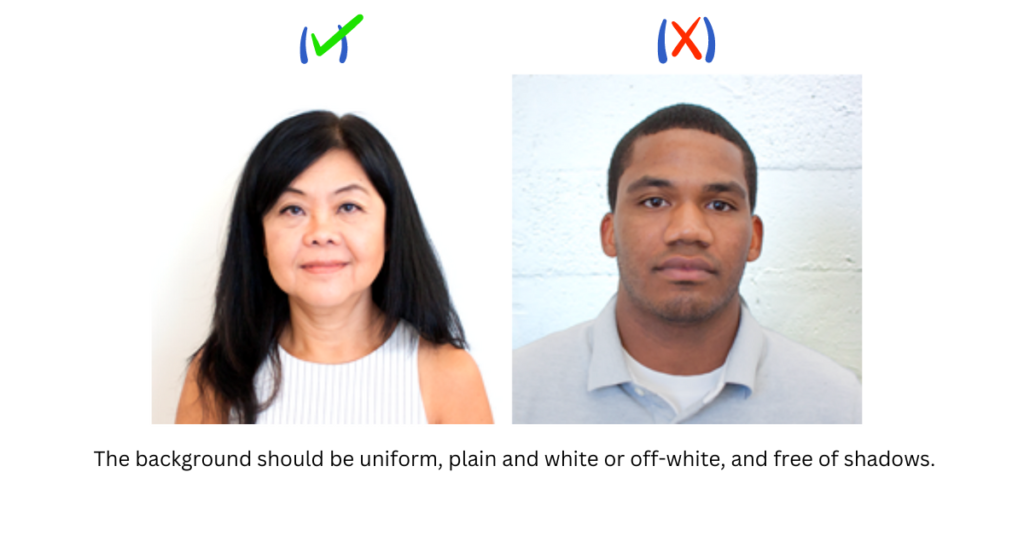
Photo Background Should be Uniform
The photo’s background should be uniform, either plain and white or off-white, and free of shadows.
US Visa Photo Requirements for Children
Children and infants must follow the same photo requirements. White background. Eyes open. Facing the camera.
No toys, pacifiers, hands, or other people should be visible in the frame. For infants, lay them on a white sheet and photograph from above. A slight head tilt is acceptable for babies who cannot hold their head upright.
If you are applying for a visa for your child to visit the USA, take the photo at home in a calm environment. Children are more cooperative when they are not in a studio.
💡 Tip: For babies, use a white towel or sheet as the background. Take many shots and pick the best one.
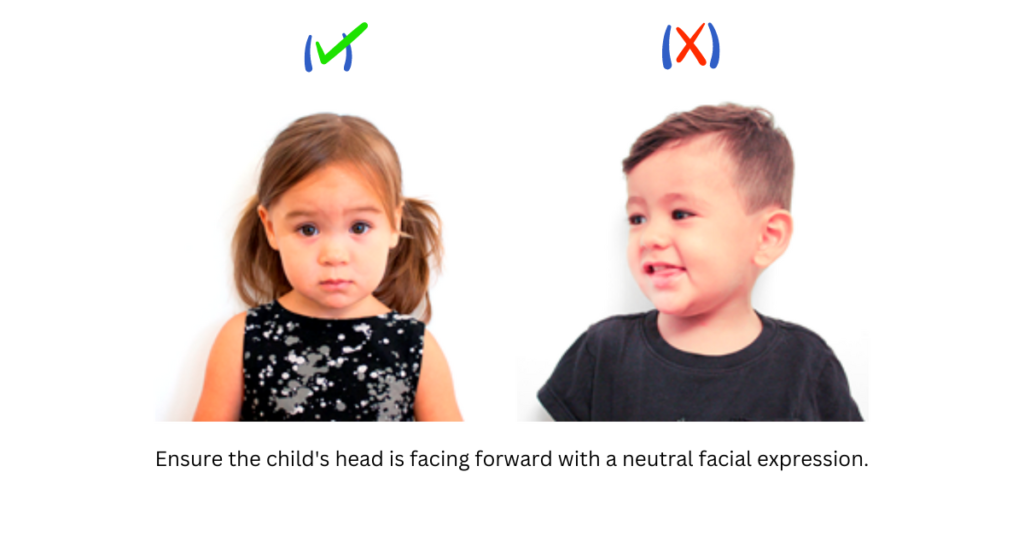
- Ensure the child’s head is facing forward with a neutral facial expression.
- No other person should be in the photo, and the child should face the camera with his/her eyes open.
- Ensure child’s hair is not covering the face.
- The child’s full face must be visible. Remove objects obscuring portions of the face.
What to Wear
There is no strict dress code. But some clothing choices cause problems.
Avoid white or off-white clothing. It blends with the required white background and makes your outline unclear. Dark colors like navy, black, or dark gray work best.
Do not wear uniforms, unless you are active military personnel or a member of a religious order and the uniform is your daily attire.
If you plan to bring a no objection letter from your employer to the interview, wear something consistent with your professional identity. It does not affect the photo directly, but it supports the overall impression.
Common Reasons for Photo Rejection
These are the most frequent issues that cause US visa photos to be rejected:
- Wrong dimensions (not exactly 2 x 2 inches or not a square digital file)
- Background is not plain white
- Shadows on the face or behind the head
- Eyeglasses visible in the photo
- Head too large or too small in the frame
- Eyes not looking directly at the camera
- Head tilted or rotated
- Photo older than 6 months
- Digital editing, filters, or AI enhancement detected
- Low resolution, blurry, or pixelated image
- File size exceeds 240 KB for digital uploads
Source: U.S. Department of State.
💡 Tip: After taking your photo, compare it against the State Department’s photo composition template before uploading.
If your photo does get rejected, it does not mean your visa is denied. You simply need to provide a compliant photo. See our page on US visa processing times to understand how resubmissions may affect your timeline.
Where to Get Your Photo Taken
You have three options.
Professional photo service.
The most reliable option. Pharmacies, post offices, and dedicated passport photo studios in most countries offer US visa photo services. Tell them it is for a US visa and confirm they know the 2 x 2 inch specification.
At home.
You can take the photo yourself using a smartphone. Use a white wall, face a window or bright lamp, and crop the image to a perfect square. Make sure all beauty modes are turned off.
US Department of State Photo Tool.
The State Department provides a free photo cropping tool on their website. It helps you crop the image to the right dimensions. It does not check quality, only size.
If you are scheduling your US visa appointment, have your photo ready before you book. Some embassy slots fill up weeks in advance, and you do not want to scramble for a photo the day before.
Frequently Asked Questions
Can I smile in my US visa photo? A very slight, natural smile is acceptable. But do not show teeth. Keep your mouth closed and your expression neutral.
Can I wear my hijab or turban in the photo? Yes. Religious head coverings are permitted as long as your full face, from the bottom of your chin to the top of your forehead, is clearly visible. The covering must not cast shadows.
What happens if my DS-160 photo upload fails? Bring a printed copy of your photo to the embassy along with your DS-160 confirmation page. The consular officer can accept it in person. Source: State Department Photo FAQ.
Can I use the same photo for a visa renewal? Only if it was taken within the last 6 months and meets all current requirements. Photos from a previous application that included glasses will not be accepted.
Do babies need a separate photo? Yes. Every applicant, regardless of age, must have their own compliant photo. No other person, hands, or objects should be visible in the frame.
Is a selfie acceptable? Technically, yes, if it meets every specification. But selfies often produce distortion, incorrect angles, and shadows. A front-facing photo taken by another person or a tripod is safer.
What if my appearance has changed since the photo? If you look significantly different at the interview, for example new facial hair, different hairstyle, or major weight change, the officer may ask for a new photo or it could cause processing delays.
💡 Tip: Buy travel health insurance before your trip.
Check out popular travel insurance plans and choose one that suits you.
Most plans only cost less than $20 a day.
Disclaimer
Photo requirements may change. Always verify the latest specifications on the official U.S. Department of State photo requirements page before taking or submitting your photo.
Rules can change. Always confirm on the official government immigration site before applying.
This page is for general guidance and is not legal advice. VisitVisaGuide.com is not affiliated with any government, embassy, or consulate.

Leave a Reply